Financing the Future of Anticipatory Action: The 14th Global Dialogue Platform Convenes in Berlin
Anticipatory action has become an established way to protect people before predictable crises strike. Acting before a shock occurs, or before it fully unfolds, can save lives and livelihoods, reduce humanitarian impacts, preserve dignity and make better use of scarce resources. T
Anticipatory action has become an established way to protect people before predictable crises strike. Acting before a shock occurs, or before it fully unfolds, can save lives and livelihoods, reduce humanitarian impacts, preserve dignity and make better use of scarce resources. The question now facing the sector is less whether the approach works and more how to finance it, connect the many efforts underway and build systems that can operate at scale.
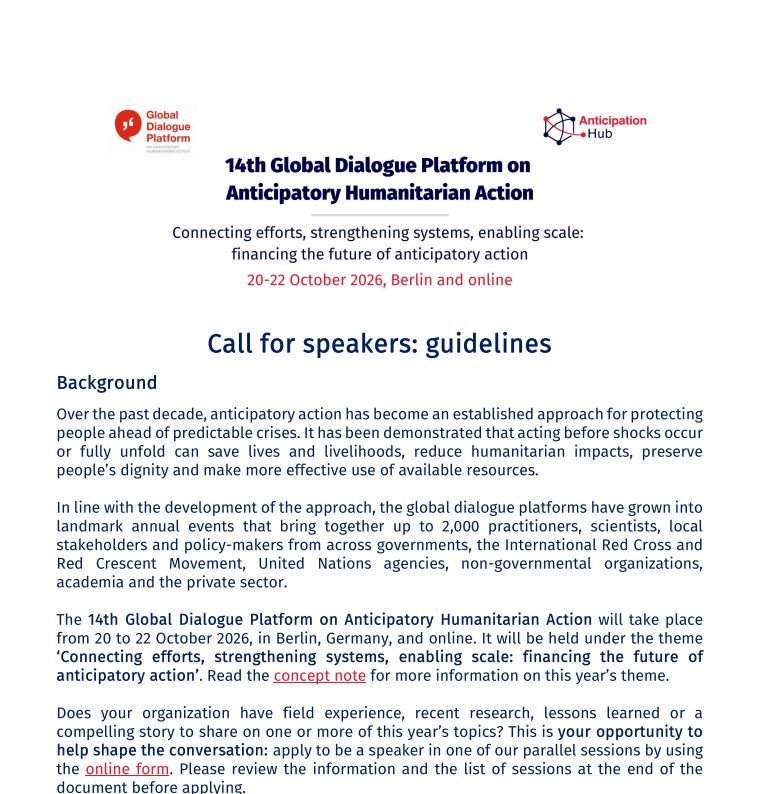
That question sits at the centre of the 14th Global Dialogue Platform on Anticipatory Humanitarian Action, which takes place from 20 to 22 October 2026 in Berlin, Germany, and online. The event carries the theme “Connecting efforts, strengthening systems, enabling scale: financing the future of anticipatory action.”
A landmark gathering
Over the years, the global dialogue platforms have grown into annual events that bring together up to 2,000 people. Participants include practitioners, scientists, local stakeholders and policymakers from governments, the International Red Cross and Red Crescent Movement, United Nations agencies, non-governmental organisations, academia and the private sector. That breadth is the point. Anticipatory action depends on coordination across humanitarian, development, climate and government actors, and the platform gives them a shared space to compare experience.
The event is organised by the Anticipation Hub, an initiative of the German Red Cross, the International Federation of Red Cross and Red Crescent Societies and the Red Cross Red Crescent Climate Centre. Partners include the Food and Agriculture Organization of the United Nations, OCHA, the World Food Programme, the START Network, Welthungerhilfe and the Danish Refugee Council. It is supported by German Humanitarian Assistance.
Speakers chosen through an open call
The organisers have taken a new approach to the programme. Previous editions drew more session proposals than there were slots, so this year the partners developed the parallel session topics in advance and are selecting speakers through an open call. The aim is to make the most of available programme space and to ensure that each session brings together complementary experiences from different regions and stakeholder groups.
Organisations with field experience, recent research, lessons learned or a compelling story on one or more of the year’s topics are invited to apply through the online form and to review the list of sessions before doing so.
A focus on children
One session will look at child-centred anticipatory action. It will argue for placing children at the centre of anticipatory efforts, on the grounds that early investment in children protects and strengthens human capital. Early action, the session’s framing suggests, can reduce long-term effects on health, nutrition, education and protection, and can generate significant social and economic returns. Participants will hear examples and first learnings from practice.
Joining the conversation
Attending online or in Berlin requires registration through the event website, where the agenda is also available. For a sector that has spent a decade proving the value of acting early, this year’s platform asks a harder question: how to pay for it, organise it and sustain it. The answers will matter for the communities that anticipatory action is meant to serve.
Event details: 14th Global Dialogue Platform on Anticipatory Humanitarian Action, 20–22 October 2026, Berlin and online.
More information, agenda and registration: events.anticipation-hub.org
19
0
Open source reference →
Leave a comment