
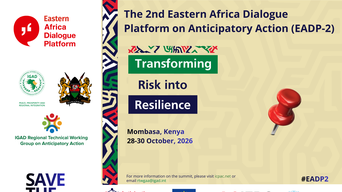
2nd Eastern Africa Dialogue Platform on Anticipatory Action (EADP-2)
The 2nd Eastern Africa Dialogue Platform on Anticipatory Action (EADP-2) will take place 28-30 October 2026, in Mombasa, Kenya, under the theme: "Transforming Risk into Resilience: Institutionalizing Anticipatory Action through Localisation, Multi-Stakeholder Coordination, Sustai
MOMBASA, Kenya — With millions of people across Eastern Africa facing hunger, displacement and increasingly complex climate-related emergencies, governments and humanitarian organisations are under growing pressure to change how they respond to disasters.
Rather than waiting for floods to destroy homes or droughts to devastate livelihoods, regional leaders are seeking ways to ensure that scientific forecasts trigger action before communities suffer significant losses.
That challenge will dominate discussions at the 2nd Eastern Africa Dialogue Platform on Anticipatory Action (EADP-2), scheduled for 28–30 October 2026 in Mombasa, Kenya.
The three-day gathering will bring together government representatives, humanitarian agencies, climate scientists, researchers, development partners and civil society organisations to explore how anticipatory action can become a permanent part of national disaster management systems.
The meeting comes against a backdrop of worsening humanitarian pressures across the region.
According to the event's concept note, approximately 48.5 million people in Eastern Africa required humanitarian assistance as of December 2025, representing about 20% of the global humanitarian caseload.
An estimated 36 million people were projected to face crisis-level food insecurity or worse between June and September 2025, while 25 million people remained displaced across the region by February 2026.
The humanitarian crisis has been compounded by conflict, disease outbreaks, repeated climate shocks and a shortage of funding.
Only 34% of the US$8.6 billion requested for humanitarian assistance in 2025 had been mobilised, according to figures cited in the concept note.
For governments and aid agencies, these pressures have raised a difficult question: can acting before disasters happen save more lives and protect livelihoods while reducing the growing cost of humanitarian emergencies?
Acting before disaster strikes
At the centre of the discussions is anticipatory action, an approach that uses weather forecasts, early warning information and risk analysis to trigger preventive measures before a predicted hazard causes serious harm.
For communities living along flood-prone rivers, this could mean receiving timely warnings, moving livestock to safer ground or protecting essential household assets before floodwaters arrive.
For farmers facing drought, early action could involve receiving agricultural advisories, securing water supplies or accessing assistance to protect crops and livestock before conditions deteriorate.
But translating scientific forecasts into meaningful action remains a major challenge across Eastern Africa.
While meteorological agencies have improved their ability to monitor and predict weather-related hazards, gaps remain in communicating warnings to communities and ensuring that governments and humanitarian organisations have the resources to act.
In many rural and underserved communities, access to timely information is constrained by language barriers, limited communication infrastructure and weak connections between national early warning institutions and local populations.
The Mombasa meeting will examine how early warning systems can be strengthened to ensure that information reaches those at risk in languages and formats they understand.
Particular attention will be given to combining scientific forecasts with indigenous knowledge, strengthening community participation and improving the use of local communication networks.
The role of journalists and broadcasters is also relevant to this challenge.
Local radio stations and community media can help explain weather forecasts, communicate potential impacts and provide practical information about the actions people can take before disasters occur.
For a farmer, knowing that heavy rainfall is expected may not be enough. What matters is understanding when the rain could arrive, how it might affect crops or livestock, and what precautions should be taken.
Moving beyond short-term projects
The upcoming dialogue builds on the first Eastern Africa Dialogue Platform held in Mombasa in October 2024, which resulted in a 17-point regional agenda known as the Mombasa Declaration.
The declaration called for stronger government leadership, improved early warning systems, greater community participation and more coordinated approaches to anticipatory action.
Since then, regional efforts have supported the development and strengthening of national anticipatory action roadmaps in countries including Uganda, Kenya, Somalia, Ethiopia, South Sudan, Sudan and Djibouti.
However, one of the persistent challenges is that many anticipatory action initiatives remain dependent on short-term projects and external humanitarian funding.
Organisers of the second dialogue want to see a shift towards government-led systems supported by national policies, established coordination mechanisms and predictable financing.
Under the theme “Transforming Risk into Resilience: Institutionalising Anticipatory Action through Localisation, Multi-Stakeholder Coordination, Sustainable Financing and Evidence-Driven Policy,” participants will assess progress since 2024 and identify what needs to change.
Discussions will explore how governments can incorporate anticipatory action into national disaster management plans, development strategies and public financing systems.
The meeting will also examine opportunities to use climate finance, contingency budgets, insurance mechanisms and social protection programmes to make resources available before emergencies escalate.
Putting communities at the centre
Another major issue on the agenda is who makes decisions about disaster preparedness and whose knowledge informs those decisions.
Although early warning information is often generated by national and regional scientific institutions, the consequences of disasters are experienced at community level.
Organisers argue that local communities should play a greater role in identifying risks, designing preventive measures and determining how anticipatory resources are used.
The dialogue will therefore examine how local organisations, community groups and national institutions can work together to develop approaches that reflect the needs of vulnerable populations.
This includes addressing the barriers faced by women, people with disabilities, displaced populations and communities affected by conflict.
Participants will also consider how technological innovations, including artificial intelligence, satellite observations and mobile communication systems, can improve forecasting and the delivery of early warning information.
But technology alone will not resolve the challenge.
Effective anticipatory action also depends on public trust, strong institutions, clear communication and the ability to release resources when warning thresholds are reached.
A test of regional commitment
The three-day meeting will feature high-level discussions, technical sessions, interactive workshops and exhibitions showcasing research, early warning tools and community-based approaches.
An evening town hall discussion with live media coverage is also planned to broaden public engagement on regional anticipatory action priorities.
The platform is expected to conclude with a new regional declaration outlining commitments to strengthen government leadership, improve coordination, expand sustainable financing and place communities at the centre of anticipatory action.
The declaration will build on the commitments made in Mombasa two years ago, with a focus on translating regional ambitions into practical national and local measures.
For Eastern Africa, where successive droughts, floods and humanitarian emergencies continue to threaten millions of lives, the outcome of the discussions could help shape how governments prepare for future disasters.
But the success of the initiative will ultimately be measured beyond conference halls and policy declarations.
It will depend on whether a farmer receives useful information before crops are destroyed, whether families in flood-prone settlements can move to safety in time, and whether governments can release resources before an emergency becomes a humanitarian catastrophe.
The challenge facing Eastern Africa is no longer simply predicting the next disaster. It is ensuring that warnings lead to action while there is still time to protect lives and livelihoods.
14
0
Open source reference →
Leave a comment